What did people take home from the 2026 Masorti Europe Conference in Paris? For many, it was the value of meeting face to face: finding connection across languages and communities, gaining perspective on the different challenges Jews face, and recognising the strengths we share. Here, some of the people who gathered in Paris reflect on what the conference meant to them.
Bruce Rigal, Masorti Europe Executive Committee Member
I came back from Paris with a real sense of delight at the strength of the European Masorti movement. Nearly 200 people came together, with participants from more countries than ever before. It felt like our most international conference yet: less focused on the host community than our gathering in London two years ago, and more connected to the movement across Europe and beyond.
The conference opened with a brilliant speech from Izzi of Noam UK about what Masorti and Noam stand for, and why young people need a voice. Young people listen to one another, she said, because the adults often don’t listen to them. The speech set the tone for much of what followed. Margo, Chair of Masorti Olami, spoke after her and said: “Izzi, you are a hard act to follow! Someday, when I grow up, I want to be just like you!”
We heard a number of clear definitions of Masorti Judaism. In my session, I drew on Rabbi Adam’s two-question definition of Masorti Judaism. 1. Do you agree halakha is binding. 2. Do you agree halakha changes slowly over millennia via Rabbinic legislation. From the bimah, Yizhar Hess said he liked Masorti UK’s simple definition: “Traditional Judaism for Modern Jews.”
Rabbi Geza offered another image that stayed with me. Masorti is at the centre, she said, but between black and white there isn’t grey: there is a rainbow. That captures something important about us. We are not a halfway point between other movements; we are authentic Judaism with room for a rich diversity of practice and belief.
The sessions and conversations carried a strong note of hope. Rabbi Jacob Blumenthal spoke with optimism about the role we can play in the Jewish world and beyond, and about the longer-term implications of the recent “blue wave” in the United States. Izzi spoke about what young people can contribute, and Yizhar reminded us that this is not the worst time in history to be Jewish. We are much better off than Jews were 80 or 500 years ago, and we have a responsibility to make the most of the possibilities before us.
We welcomed a new Kehilla in Genoa, Etz Haim. Nic also reminded us that every Kehilla needs to be represented, and that many are still missing, particularly from the UK.
Gill Caplin, founder and first chair introduced the theme of honouring our roots and shaping our future and how neither can be done in isolation.
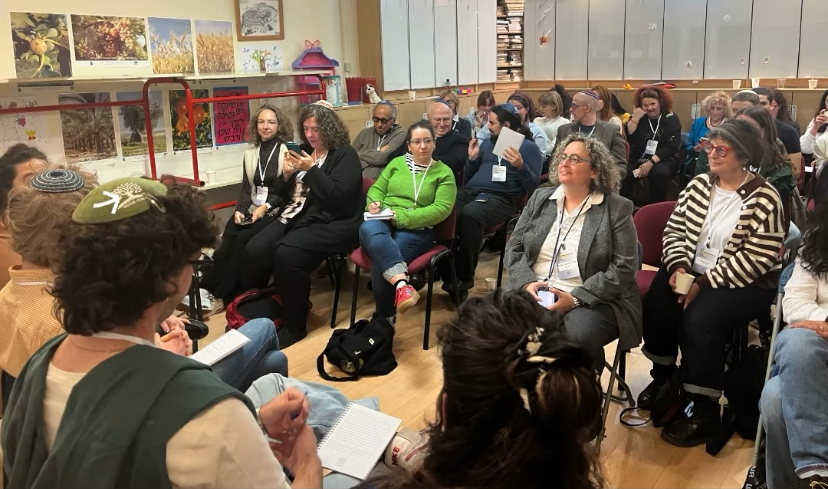
Martha Limburg chaired a fascinating session investigating new creative ways of building community beyond bricks and mortar.
The two Shabbat gatherings at separate locations worked very well, and we all came together on Sunday. The services at Adath Shalom where I was, were wonderful, with Ashkenazi, Sephardi, French and familiar Masorti UK minhag woven together. The music was predominantly Sephardi, led by an extraordinary operatic cantor who drew the congregation in rather than singing over it. A small group provided a continuous, distinctive backing note.
Rabbi Jeremy Gordon’s drasha was fun and participatory: he had us singing and blessing one another in pairs. The warmth between Rabbi Ollie, Nic and Rabbi Josh was clear, as was the friendship they built through Noam. Rabbi Josh’s sermon was excellent, delivered in front of his father, Rabbi Chaim Weiner, and many of the senior rabbis in the Masorti and Conservative worlds.
I left Paris encouraged by the strength of our connections, the breadth of the movement and the confidence of the next generation. There was a clear sense that Masorti can stand for rooted Jewish life, genuine diversity and a hopeful, inclusive future.
From Tehila Reuben, Interim CEO of Masorti Olami
‘Masorti Olami helps support, build and develop Masorti communities across Europe, Latin America, Africa, Australia and Asia. Communities like yours. I have the absolute privilege of having a job that involves finding a way to empower and help support all of you – our Masorti community members and leaders in our movement.
I am often asked which community I am a part of at home, in Jerusalem. My answer is always: the Masorti Olami Community. I don’t have just one home community. Every time I get on a zoom with one of you or am lucky enough to visit your Masorti community in person, that’s my community. That’s when I feel at home. And this shabbat, this weekend, here with all of you – that’s exactly what I felt. At home. With almost 200 family members and friends.
And I think that this is our strength. We can so easily focus on the politics, the darkness, the challenges, the intolerance. Those things are real. But so is this: the community around us, and what we have achieved together this weekend. This conference was about more than an institution, or a list of goals and outcomes. Its purpose was simple: to celebrate how far we have come in over 20 years, despite those challenges, and to connect with each other to make the world a better place. That is our strength. That is where our work lies. There is still so much good that needs to be done: in our world, within our communities and across our movement. I leave proud and inspired to have you as partners in that work. We are stronger together. And in two days, when we’re back with our families and our busy lives, remember that new person you met here in Paris because this network brought us together. Don’t let that connection end here.
I’m leaving our Paris conference with a very personal feeling of belonging, and a responsibility to help more people feel it too. That’s the work ahead of us, together. Let’s take what we felt here in Paris back to our communities and keep building from there.’
From Dr. Yizhar Hess, Vice-Chair WZO
‘Returning from Paris, I am filled with immense pride. European Jewry is facing turbulent winds; antisemitism is a deep-seated psychosis with no simple cure, and the day-to-day challenges confronting our communities are real and heavy. Yet seeing the remarkable, dedicated Masorti leadership on the ground in France and across the continent gives me boundless hope. They understand what history has always taught us: we do not defeat hatred by shrinking, but by standing tall in our Jewishness. The true answer is building vibrant, proud Jewish life — a traditional Judaism for modern Jews that embraces our heritage while engaging fearlessly with the modern world. In a complex Europe, Masorti Judaism is not just enduring; it is leading the way forward.’
Martha Limburg, Masorti Judaism UK Director of Communities
‘What I’m taking back is that we share many of the same challenges, questions and successes, and that we are stronger together. Masorti is an invigorating, exciting movement, and I feel lucky to be part of it.
I was also reminded that support is there if we want it: there’s always someone who can help us think something through or share their experience of something similar. And, as always, being together in person was wonderful.
I was especially inspired by Rabbi Jacob Blumenthal, who said: “In a world that moves towards polarities and extremism, Masorti Judaism is a place of complexity and nuance — a “both-and” approach to Jewish life. Among other values, we balance Jewish tradition with modernity, concern for the Jewish people with the welfare of all humanity, and individual experience guided by halakhic expression of communal expectation.”
From Rabbi Josh Weiner, Adath Shalom, Paris
‘That is something we need to recognise at a gathering like ours: not only the challenges facing Masorti communities and Jews today, but also the potential for blessing we carry within us. We are the sons and daughters, the inheritors, of Abraham’s legacy. When our ideas and contributions come from a place of modesty and kiddush Hashem, they can benefit humanity.’
https://rebjosh.substack.com/p/blessed-with-everything
From Jacob Blumenthal, Chief Executive Officer of both the Rabbinical Assembly and the United Synagogue of Conservative Judaism (USCJ).
‘It was thrilling to be together with lay leaders and rabbis from across Europe, and to see how we are creating thriving, joyful communities that embrace Jewish tradition while helping it evolve to meet today’s reality. The energy, creativity, and commitment among the attendees was truly inspiring.’
From Rabbi Jeremy Gordon, Rabbi at New London Synagogue
Rabbi Jeremy Gordon taught a powerful session in Paris on Walter Benjamin and his essay The Work of Art in an Age of Mechanical Reproduction, exploring the idea of “aura” and its connection to Jewish life.
He said: “Judaism is all about aura: the ability to truly encounter the reality of the thing that is directly in front of you, on Shabbat in particular, and particularly when we give a blessing from one human being to another human being.”
Reflecting on the conference, Rabbi Jeremy said:
“I brought back a real sense of delight at the strength of the European movement, and particularly Adath Shalom, now under the rabbinic leadership of Rabbi Josh Weiner.”
From Aaron Conway, Director of Noam UK
It’s the unexpected conversations you have in real life, face to face that really give a sense of how big the Noam and Marom community is, and how powerful it can be. For example, I was speaking with my counterpart in Ukraine about the possibility of an exchange: their young people visiting us, and ours visiting them – while that is unlikely to pass a risk assessment at the moment, we really hope it may be possible in the future.
It was moving to see how similar our Kabbalat Shabbat and Havdalah services are across languages and cultures. For many, antisemitism is a major concern, however our Ukrainian friends shared that for them, they have to live with the realities of war and have nowhere safe to go when the sirens sound, but they feel safe wearing Magen David jewellery and other Jewish symbols in public, in fact, they said that only 16 antisemitic incidents were reported in the country last year, and for our friends in Barcelona, they really feel antisemitism has become institutional on a much more intrinsic level. Meeting and speaking to these communities from across Europe really put things into perspective and how fortunate we are here in the UK.
From Nic Schlagman, Projects & Community Coordinator, Masorti Europe
The Masorti Europe Conference was inspirational on so many levels. Rabbi Josh Weiner, who I have known from childhood, is an inspirational rabbi with an incredible depth of soul. Our community leaders are inspiring in how they mould a develop undeniably Masorti yet distinct communities all across Europe. And our movement leadership gathered together from across the world to both lead our community and sit and learn from all those doing the hard work in small communities across the continent.
From Dr. Wanda Teplinsky, President Masorti Europe
I particularly enjoyed seeing the large youth delegation from Marom and Noam take an active role throughout the conference. There was also strong participation from communities across Europe, including some still in development, and from our partner and sister organisations. The Rabbinical Assembly, MERCAZ, the rabbinical schools and International FJMC were among those who sent representatives and joined the conversations.
Friendship and hope filled the conference, creating a wonderful atmosphere throughout three joyful days.
Jeremy Kelly, Former Chair of Masorti Judaism UK and former trustee of Masorti Europe
I first attended a Masorti Europe conference in Valencia around 2005. There were only about 20 of us. It was a lovely event, but it was extraordinary to attend this week’s 20th anniversary conference and find more than 200 people gathered from across Europe and around the world.
The conference was inspiring, uplifting and spiritual on so many levels. It brought home to me that Jewish life is global: people from many different countries can share a deep connection. It was an extraordinary experience, and the event was very well organised.
It was also wonderful to see Josh Weiner, whom I knew as a child. I remember him running around at Edgware Masorti; now he is a senior rabbi in his own right.
One of the highlights was the communal Shabbat services. People from so many countries singing together, sometimes in the very same tune, was deeply uplifting.
I was fascinated to hear how the Masorti movement is grappling with issues in Israel while also navigating the challenging times in Europe. Each community is affected by the politics of the world around it in different ways.
The most exciting part for me was speaking with Yizhar Hess of the World Zionist Organization and meeting others involved in MERCAZ. I’m returning with renewed determination and enthusiasm to support the organisation ahead of the next elections in three years’ time.
I’m excited to get involved in that work and hope to play my part in the continued growth of Masorti Europe. I also want to bring its work and impact back to the UK, so that British Jews can see that we are part of a wider movement doing incredible work, including in emerging communities across Europe.