Cathy is a long-standing member of New Essex Masorti Synagogue. She shares her grandmother’s recipe with us.
Here is my late grandmother’s recipe. Bertha Bloom, who knew this recipe off by heart, dictated it to my mum in 1972 when she was 81 years old. My mum then passed this recipe on to me. It is a moist cake that keeps for a couple of weeks, although it usually gets eaten over a few days! As you can see my nan was “a bit of this and a bit of that”. She didn’t write down her recipes, but this honey cake recipe does work and is delicious!
CATHY’S HONEY CAKE RECIPE
INGREDIENTS:
3 large eggs
6oz demerara sugar
8 fluid ounces golden syrup or liquid honey. Or a mix of both.
half a glass of oil
half glass of hot water
12 ounces self-raising flour
1 teaspoon cinnamon
2 teaspoon mixed spice
1 teaspoon ginger
1 teaspoon bicarbonate of soda
METHOD:
Beat eggs and sugar. Add ‘wet’ ingredients. Beat again. Add the dry ingredients. Beat again.
Turn into a large baking tin that has been lined with greaseproof paper which has been oiled both sides. Decorate with blanched almonds
Bake for 1 hour, regular 2 (gas oven), middle shelf. Use a skewer or sharp knife into middle of cake to see if cooked.
This is Seemah Lanyado’s recipe for maraba, an apple preserve she brought with her from Calcutta. It was shared by Gay Teper who is now at Kol Nefesh.
Gay says: ‘My mum was Flower Elias from Calcutta. The Calcutta community came to Calcutta from Aleppo (mum’s family) and Baghdad (dad’s family) 250 years ago at the time of the British Raj. Seema was part of the Calcutta community but lived in Golders Green. In India she had a goat so the milk wouldn’t be adulterated.’
Gay adds: ‘Mum did this recipe in 1980’s with 1 1b/450 gm granulated sugar to 7 apples, juice of 1½ lemons, honey, cloves instead of cardamom, making a syrup (bit thick) boiling sugar, honey, water, cloves, lemon juice.’
APPLE MARABA – PRESERVE
Ingredients
2.2 1b/1 kgGranny Smith (tart green) eating apples
1 red plum
1¼ 1b/600 gm granulated sugar
½ pint/300 ml cold water juice of 2 lemons
6 cardimum
8 oz/250 gm of honey
2 tablespoons/30 ml rosewater
Method
Peel, cut in half and core Granny Smith apples.
Put apples into flat dish (thali), core side down – keep each apple separate; do not cover.
Add 1 plum (chopped) for colour.
Add cardimum – score each one (to release flavour, but not seeds).
Bring to boil and simmer for 10 minutes in flat dish, cooking slowly on slow fire without stirring (60-90 minutes). When core side of apples are golden-brown, turn apples over.
When other side is also golden-brown, check apples are soft right through. Remove from heat when done.
Gently add rosewater.
Transfer to dish when cool and cover with cling-film.
This is a recipe Neda Rashti brought with from Persia when she moved to St Albans.
Neda says: ‘For Rosh Hashanah, I wanted to share a dish that is especially meaningful to me and reflect the Persian flavours and traditions I grew up with. Dates are one of the traditional symbolic foods of Rosh Hashanah and represent abundance and blessings for the year ahead. I hope these recipes add a little warmth and sweetness to the New Year and that the coming year brings health, peace, happiness, and many blessings to all.’
Persian Upside-Down Cake with Dates and Cardamom
Serves 8
Ingredients
For the topping
27 Medjool dates, pitted and halved
85g butter
100g brown sugar
Pinch of salt
Pinch of ground cardamom
For the cake
190g plain flour
2 tsp baking powder
¼ tsp salt
115g butter, softened
130g caster sugar
2 eggs
2 tsp rosewater
120ml buttermilk
Ground pistachios or dried rose petals, to garnish
Method
Grease a 23cm round cake tin.
Arrange the dates in the tin and sprinkle with the brown sugar and cardamom.
Whisk together the flour, baking powder and salt.
In a separate bowl, beat the butter and sugar until light and fluffy, then add the eggs and rosewater. Fold in the dry ingredients alternately with the buttermilk.
Pour the batter over the dates and bake at 180°C for 35–40 minutes, until golden and a skewer inserted into the centre comes out clean.
Allow to cool for 5 minutes, then invert onto a serving plate and garnish with pistachios or dried rose petals.
Janine bought this recipe with her from South Africa. It is very difficult to make in the UK as you have to leave the dough to dry in the sun for over an hour. The other trick is to make sure the teiglach initially cooks undisturbed under a tightly closed lid, with a tea towel tied around the lid.
Granny’s Teiglach
6 egg yolks
2 tbsp oil
2 tbsp brandy
Cake meal
Beat the egg yolks, oil and brandy together. Add enough cake meal to make a soft but not sticky dough.
Roll the dough into finger-thick sausages. Cut into lengths and join the ends to make rings.
Leave to dry in the sun for 2 hours.
For the syrup:
1 kg golden syrup
3 cups water
3 cups sugar
Bring the syrup, water and sugar to the boil and boil for 10 minutes.
Lower the teiglach carefully into the syrup. Cover the pot tightly and boil for 10 minutes.
Uncover, gently mix the teiglach, cover again and boil for another 15 minutes.
Reduce the heat and continue cooking until the teiglach are brown.
Add 2 tsp ground ginger and remove from the heat.
Carefully add 3 cups hot water and mix well.
Drain thoroughly and leave to cool on a damp board.
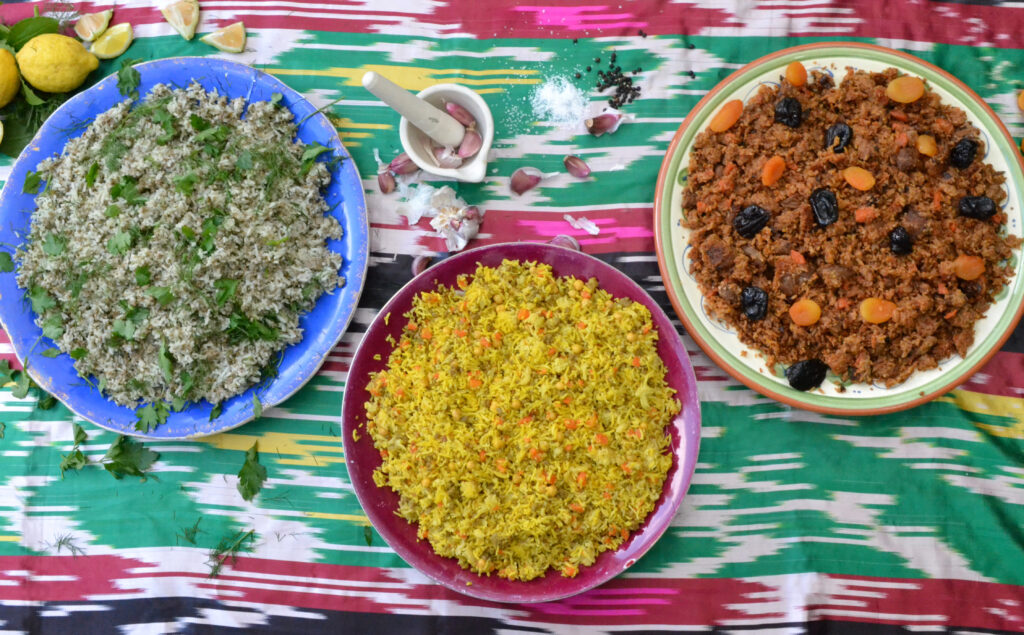
Pictured here is green rice – Buchsh, yellow rice – Seer Kaneese and red rice – Osovoh
Lilian’s mother, Miriam, was born in Jerusalem in 1926, and her father Yehuda was born in Samarkand in 1913. They were Bukharian Jews and they finally met in London – an organised shiduk! They married in London in 1949 building up a small Bukharian community living in North London. Lilian was the third daughter to be born in London. She is a member of New North London Synagogue.
Lilian has written a book about the Bukharian food she grew up with. In honour of her mother’s food, the book is called Miriam’s Table. It features over 80 Bukharian recipes using all the wonderful ingredients found along the Silk Route where there was plenty of rice, fresh vegetables and spices such as black pepper and turmeric.
Lilian remembers that at Rosh Hashanah, the family feast would feature many of the traditional foods- all based with rice, vegetables and spices making up an array of different colour rices. The green rice, pictured here on the left, is a special Jewish Bukharian dish called buchsh. Its distinctive green colour comes from spinach and parsley.
BUCHSH – green rice
Serves 8/10 people
A bold substantial rice packed with green herbs, spinach, chicken livers and beef.
Mum sometimes made the dish for vegetarians using chopped mushrooms and vegetable stock, as a substitute for the chicken livers and beef.
225g chicken livers
350g basmati rice
225g minced beef
Bunch of fresh coriander leaves chopped
Bunch of fresh dill leaves chopped
225g frozen chopped spinach – defrosted
1 chicken stock cube crumbled
2 tablespoons sunflower oil
3 tablespoons of boiling water
Salt and freshly ground black pepper
To cook; a large roasting bag.
Place the chicken livers in a saucepan and cover with cold water. Heat and bring to the boil. Remove from heat, rinse the livers and chop.
In a large bowl combine all the ingredients and mix together well. Carefully spoon everything into the roasting bag. Knot the bag close, leaving some space to allow the rice to swell. Pierce both sides of the bag and place in a large saucepan. Cover with boiling water and bring back to the boil then reduce the heat and simmer gently for about an hour.
Check every so often and make sure the bag is covered with boiling water. Carefully open the bag and pour the contents onto a large platter.
You can read more about Lilian’s return to Bukhara here:
Her book is available here: https://www.thebukhariancookbook.com