Dvar Torah related to ‘Vayigash’ and the Masorti Mission to Israel by Angela Gluck,
26 December 2025
Parshat Vayigash is a sedrah of body language, with a lot of crying and kissing, with sound and silence, between private and public domains. The dramatic irony continues from last week’s sedrah, with not everyone knowing what everyone else knows!
Although Yosef’s name means ‘increase’, another kind of greatness belongs to Yehudah. The man we see here—the one who ‘vayigash’ (approached)—has changed. He’s not the Yehudah of the shameful episode with Tamar. He’s not even the Yehudah who suggested that Yosef be sold rather than killed. Using extremely deferential language, he begs Yosef not to keep Binyamin hostage because it would grieve his father Ya’akov. He more than accepts responsibility and is willing to make a sacrifice. We can hardly recognise Yehudah, the man whose name means ‘thankfulness’. How wonderful and how challenging that we Jews—Yehudim—are named after his tribe!
It was a high-risk strategy for Yosef to create privacy and intimacy by clearing the room of his Egyptian staff: his brothers almost killed him once so he knows what they’re capable of. Now he’s exposed, without any protection. They made him vulnerable before; now he deliberately makes himself vulnerable to them. And breaks down uncontrollably, howling loudly. In that utter defencelessness and intimacy, he blurts out two simple words: Ani Yosef—I’m Yosef. Is it the pent-up pain and longing of all the years now finally being released? Is it his guilt about his own arrogant behaviour? Joy that he can finally be himself? Who knows?
But we do know that he gets all the other brothers to approach. He falls on Binyanim’s necks—yes, plural. And he cries on his necks. But why Binyamin’s necks? Did Yosef fall on both sides of Binyamin’s neck—hugging him from left to right? Did he cuddle him completely, embracing both sides of his face? Or did Yosef fall on Binyamin’s neck more than once? Did Binyamin reciprocate? Was Yosef drawing together two eras and areas of his life? Or is it entirely metaphorical? There is, with Yosef and Binyamin, not only recognition and relief, but also renewal.
One reunion is still to come: Ya’akov and Yosef. Their encounter also involves the neck and we’re given a picture of profound catharsis. There may have been deep feelings and strong reactions but also emotional paralysis and spiritual numbness. Yosef could still weep. Ya’akov was long finished with weeping. Perhaps he’d cried all his tears away and he’d already become Israel—the one who struggles with God—through the pain he had experienced and wrestled with. By contrast, Yosef is ready to cry buckets.
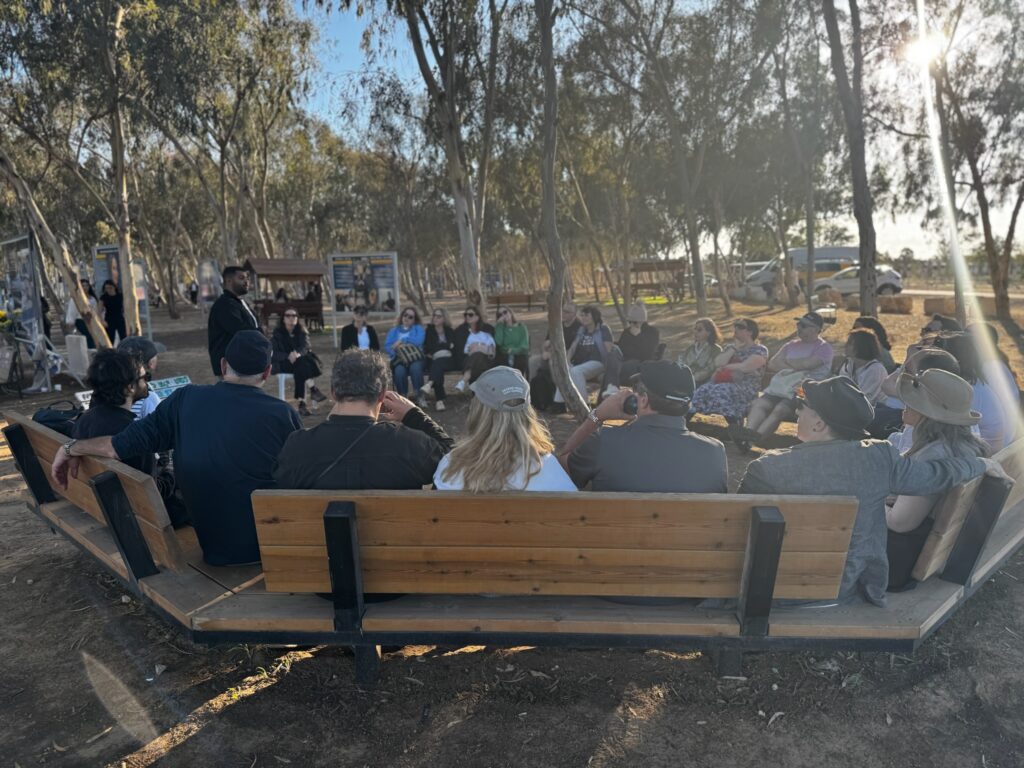
In early December I had the huge honour of being in the Masorti group visiting Israel for a few days, aiming to understand Israeli society since 7 October. We witnessed a great deal of pain that was experienced and wrestled with. I know that I am changed forever. Many of the encounters resonated with characters in Parshat Vayigash—their responses to situations or the values that they espoused. It is as if we communed with all of Yosef’s family in the ‘Gaza Envelope’ and ‘Hostage Square’.
These are three of them…
Zohar Livni Mizrachi, committee head at Kibbutz Re’im, lamented the end of close collaboration with communities in Gaza, especially the loss of trust. How they’d provided work, given meals and extended party invitations… and how they were utterly betrayed because it was workers from Gaza who’d built their mamadim—their safe rooms—knowing precisely where they were located and that the doors never had locks. It was the openness and big-heartedness that kibbutz members had shown that made them vulnerable to attack.
Gazing and half-pointing in the direction of the Gaza Strip, Zohar declared, “I used to say it was Palestine over there. Now it’s Gaza. I don’t wish them harm and will never do them harm. But actually I don’t care any longer. I’m just trying not to despair.” I saw Ya’akov in her. She’d long since cried herself out.
Daniel Sharabi was an experienced combat medic who’d been preparing to leave for training as a pilot a few days after 7 October. Being at the Nova festival was going to be his going away party and he’d thought it would be beautiful to arrive as dawn was breaking, to see faces in the early morning light. It meant that as people were running out, he was running in. For eight hours, he gave the medical aid he could, improvising bandages and tourniquets. He was wounded himself and still has shrapnel in his arm. Some of those he was with were captured. Some were murdered.
Now—Yosef-like—he’s converted his pain into purpose, changing focus and re- skilling as a provider. He’s turned his attention to sorely needed psychological recovery, through creating with his brother a charity to offer a range of therapies and healing activities for survivors of the festival. They’d been strangers before and not a community as such. What binds them is what happened to them that morning.
I know I wasn’t alone in feeling both humbled and inspired simply to be in Daniel’s presence. Remember his name: Daniel Sharabi; he has a sharp mind, a huge heart and wide arms. I was probably one of the last to leave his talk to us and we must have seen something in each other’s eyes because we hugged. On both of our necks.
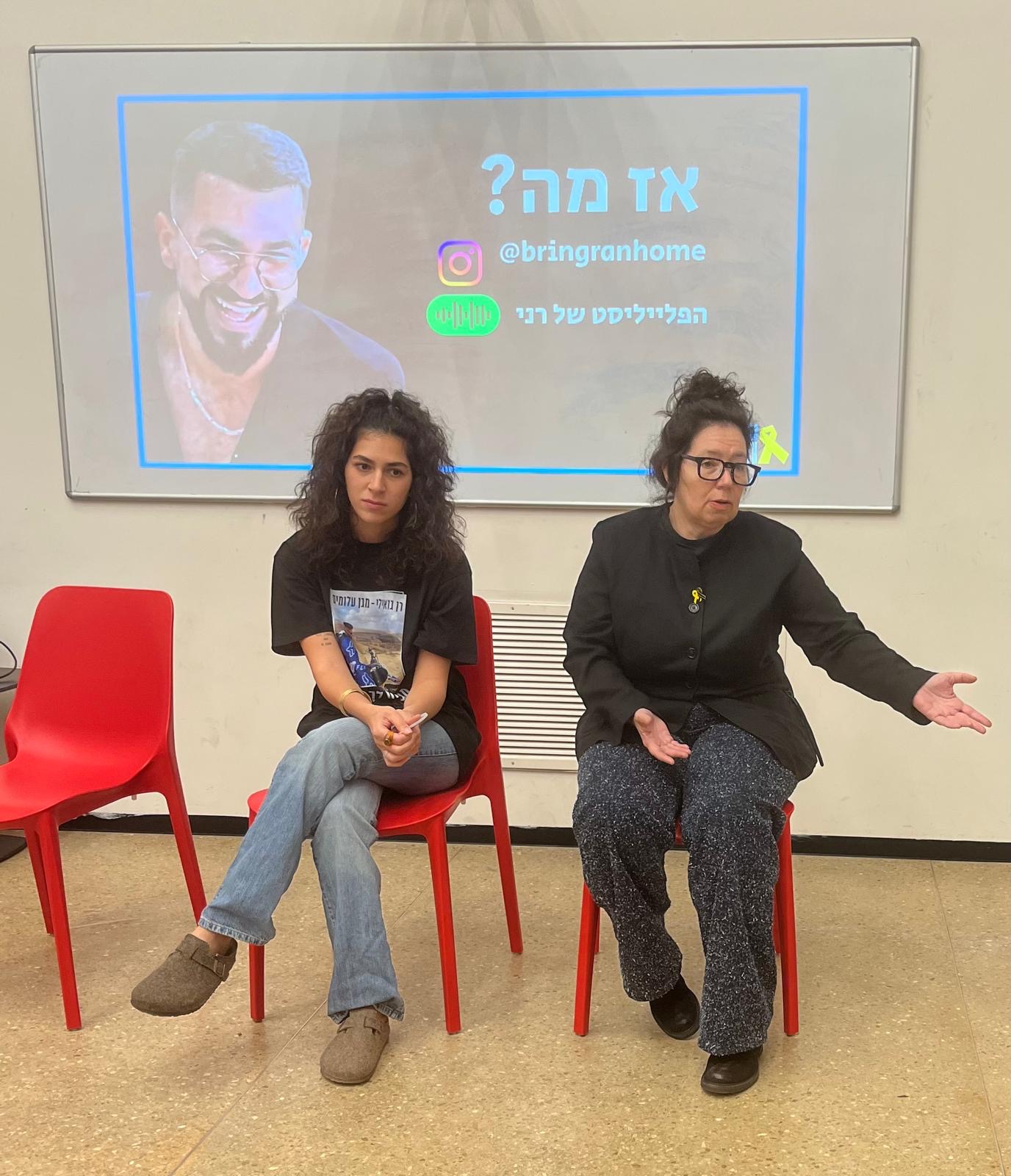
Still in Gaza—the very last hostage—is Police Master-Sergeant Ran Gvili,
thought to be dead.
When I think of Yosef keeping Binyamin—his only full
brother—with him, I appreciate that there are hostages of love and longing, and
then there are hostages of death and destruction.
We were blessed—and perhaps overwhelmed—to meet Shira, Ran Gvili’s sister.
Through an interpreter, she told us what he was like, what happened to him
and how Israelis have been responding. You don’t need to have siblings for
your heart to bleed.
I wanted to say something but had no idea what.
It’s not because I regrettably haven’t spoken Hebrew fluently for many years.
It’s more a case of אין מילים
there are no words.
Yet Shira found some. When I approached—‘vayigash’-style—she held my
arms lightly and fixed me with her gaze, repeating what her interpreter had said for her and what I’m sure she herself had said to others umpteen times.
She said:
Rani is still alive.
I’m certain.
I believe deep in my heart. I have hope.
עוד רני חי. אני בטוחה. אני מאמינה עמוק בלב. יש לי תקווה.
I immediately thought of Ya’akov’s sons telling him that Yosef was still alive and
him echoing that Yosef his son was still alive.
There are times to discuss the similarities and differences between certainty, belief and hope; but not now. This is also not the point to decide whether Shira lacks a sense of realism. Anyway, she’s absolutely right: her brother Rani will never die.
Parshat Vayigash has the distinction of being the only sidrah not to end with a petuchah—like a paragraph break, with the following words starting a new line. Rather, Vayigash runs straight into the next portion, Vayechi. It symbolises an ongoing narrative: with recognition came reconciliation and then renewal. It betokens the story of our survival and of our revival.
עוד יוסף חי
Yosef is still alive is the theme of this parashah. And resoundingly the theme of our experience in Israel was that the Jewish people is still surviving and thriving and aliveing. For all our contentions and conflicts, all our trials and tribulations, all our passions and pains,
Am Yisrael Chai—The Jewish People is still alive.
עם ישראל חי