There is a fun children’s story book that may be very familiar to you, by Richard Scarry called What Do People Do All Day? It is full of the busy life of a town (just like Finchley)— train drivers, doctors, builders, farmers, police officers, firefighters — all doing the work that keeps ordinary life moving.
The President of the UK Supreme Court, Lord Reed thought that we needed a version called: What Do Supreme Court Judges Do All Day?[1] to explain the work of judges and the Court. He delivered a lecture on exactly this topic earlier this year.
It’s a fair question. From the outside, judging can look simple: hear both sides and then decide who is right: Facts go in, law is applied, answer comes out.
But one of the privileges of working at the Supreme Court has been seeing, close up, how careful and demanding judgment really is: the research, the reading and re-reading; the quiet hours with papers; the testing of arguments; the discussions with colleagues; the drafting, revising, rethinking; the discipline of putting aside personal instinct and asking instead: what does the law require?
And I have also seen something else. Behind the points of law, the bundles of documents, the careful language of judgments — there are nearly always people.
Lady Rose, a Justice of the Supreme Court, has spoken[2] about how, when she first became a judge she was often struck by the human drama behind cases that looked, on paper, almost entirely technical. A dispute might appear in the law reports as a dry question about the interpretation of a section of the Companies Act or the Insolvency Act. But there are people who feel wronged. People who have lost something. People who are anxious, angry, exhausted, hopeful. People for whom this is not an abstract legal exercise.
By the time a case reaches the Supreme Court, the people involved have often invested not only time and money, but hope, fear and a deep need to be heard. In court, there will always be a winner and a loser. But if the process has worked properly, even those who lose should be able to feel that they were listened to, that their argument was taken seriously, that the reasons were clear, and that justice was done.
There is a beautiful echo of this in the story of Jethro advising his son-in-law Moses in the Book of Exodus[3]. Moses is exhausting himself hearing all the disputes of the people. Jethro tells him to appoint others to share the burden of judgment, and says that if Moses does this, “all these people will go home in peace.” The rabbis notice that phrase: not only the people who win, but also the people who lose. A good system of human justice does not only produce outcomes. It also gives people a process through which they can accept those outcomes, even when they are painful.
That does not mean that a judge decides by sympathy or emotion. The law must be applied consistently and fairly. Compassion cannot mean bending the law towards the person we feel most sorry for. But nor is compassion irrelevant. A judge who cannot see the people behind the case may miss something essential about the dispute itself. Good judgment requires enough distance to be fair, but enough humanity to understand what is really at stake for the people before you.
So, justice is not the opposite of compassion. At its best, justice requires compassion — not as a substitute for law, but as part of the wisdom needed to apply law well.
Human justice is serious because the stakes are serious. Courts deal with liberty, responsibility, reputation, property, family, livelihood, sometimes life itself. They decide disputes that may have shaped people’s lives for years. They name wrongdoing. They protect rights. They apply the law carefully and consistently, using legal reasoning. And in doing so, they help sustain something both fragile and essential: trust that society is not simply governed by power, instinct or revenge, but by the rule of law.
And if that is true of human judgment, how much more might it be true of divine judgment?
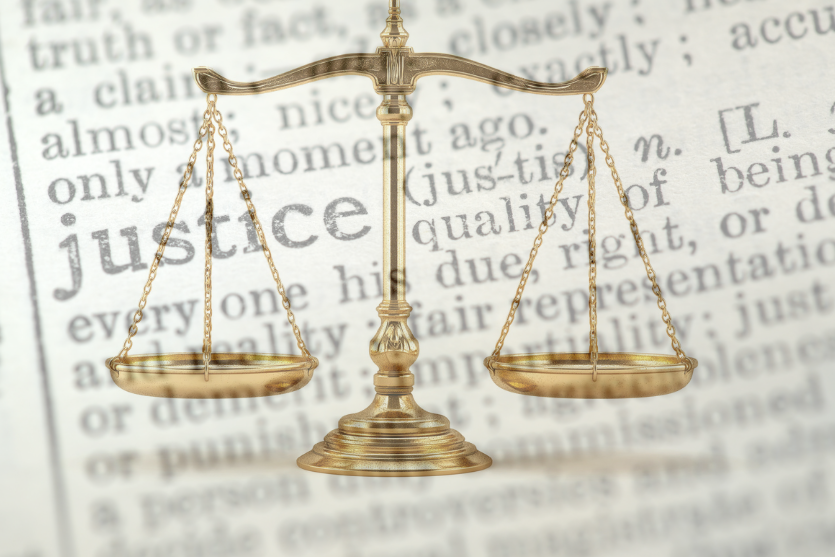
Our liturgy calls Rosh Hashanah Yom HaDin – the Day of Judgment. We may instinctively imagine God as a kind of supreme court above the Supreme Court: a judge with a larger bench, a fuller record, a more final verdict. The Mishnah[4] teaches that on Rosh Hashanah all the inhabitants of the world pass before God. The world becomes a courtroom. God is the judge scrutinising us individually. And each of us is asked to give an account of our life.
For many of us, that is not an easy image. Perhaps this is partly because of our associations, experiences and even misperceptions about the human justice system. It can sound as though our lives are being reduced to a charge sheet, cold and punitive: the things we did, the things we failed to do, the words we wish we could take back, the opportunities we missed.
But I am not sure that is the right image. Divine justice is not simply human justice magnified. It is something different in kind.
However serious and important, a human court cannot judge everything. It cannot judge the whole of a person’s life. It cannot see fully into the heart. It cannot know every pressure that shaped an action, every fear that lay behind a decision, every inherited wound, every consequence that will ripple out from one moment into the lives of others. It cannot know or judge the full measure of moral guilt.
Human justice asks: what happened? What can be proved? What does the law require? What responsibility can properly be attributed to this person, on this evidence, in this case?
Divine justice asks something deeper: who are you? What have you done with the life entrusted to you? Where have you caused hurt? Where have you been hurt? What have you inherited? And who might you still become?
That is both more frightening and more hopeful.
It is frightening because, before God, nothing is hidden: not our evasions or excuses, nor the moments when we knew what was right and chose what was easier. We are answerable and out life has moral seriousness. Rosh Hashanah asks us to stop, pause and stand in the uncomfortable truths of our life.
But it is hopeful, because God sees more than our failures: the pressures that shaped us, the wounds we did not choose and the possibility of change still within us. To be judged by God is not to be reduced to the worst thing we have done. It is to be seen whole.
I find this very powerful: the terror of Rosh Hashanah is that we are fully known. The comfort of Rosh Hashanah is that we are fully known — and still called back each year.
And that is where justice and mercy begin to meet.
The rabbis give us a beautiful image for this. In the book of Daniel[5] there is a strange verse which speaks of “thrones” being set in place before God. The Talmud asks: why thrones, in the plural? Why would God need more than one throne?
One answer is that God has, as it were, two thrones: one throne of justice and one throne of mercy. On Rosh Hashanah he sits on both.
That image matters because it tells us that justice and mercy are not opposites in God. They are both essential components of divine judgment. Judgment tells us that our choices matter. Mercy tells us that our worst choices need not be the final word.
If justice asks us to face the past, mercy gives us the courage to imagine a future. Rosh Hashanah needs both: the honesty to say, “This is what I have done,” and the mercy to say, “This is not all that I can be.”
And between them lies the possibility of teshuvah: the possibility that truth and courage can open the door to change. And that brings us to the heart of the day.
The story of Jacob Dunne is a compelling example. In 2011, as a young man, he threw a single punch that killed another young man, James Hodgkinson. He was convicted of manslaughter and sent to prison. The law did what human justice must do: it named the offence, imposed a sentence and marked the seriousness of the harm.
Jacob left prison pretty much the same as he had entered it: homeless, unemployed and struggling to find a sense of purpose.
But that was not the end of the story.
Through restorative justice, Jacob later met James’s parents, Joan and David. He had to face the real life consequences of his action and the family whose world had been changed forever. Towards the end of their meeting, Joan and David asked Jacob a life-changing question: “What do you intend to do with your life now?”
The encounter did not undo the harm. Nothing could. Nor did it ask James’s parents to forget or excuse what had happened. But it forced Jacob to both confront the reality of what he had done and gave him the possibility of believing there could be a different future, not one soley governed by the past
With the help of others, one step at a time, no heroic leaps, many setbacks, he returned to education, and eventually graduated with a degree in criminology. He now works to help others turn their lives around. One step at a time, a life turns.
That is teshuvah at its most profound. It does not pretend that the past did not happen. It does not ask others to forget. It makes the harder, braver claim that the past, though real, need not have the final word.
Of course, the work of teshuvah is deeply personal. No one else can make our apologies, face our regrets or repair what only we can repair. But personal does not mean alone.
Rosh Hashanah draws us into community because none of us can do the work of change entirely by ourselves. We come to shul. We stand beside one another. We pray in the language of we. In effect, we are saying to each other: you are not alone in having fallen short; you are not alone in needing to begin again. Community strengthens our capacity to undertake the changes demanded of us on Rosh Hashanna. This is the power of us: together, we can be a community in which change becomes possible and where no one has to take the first step towards change entirely alone, supported to believe in the possibility that this year can be different from the last.
So let us all ask of ourselves (and discuss over lunch!): What is one thing I will choose differently this year? How will I help us be the kind of community in which change is possible for all of us?
As we stand together in this moment of judgment and mercy, let us have the courage to take one step at a time towards change. Let’s build a community in which truth is spoken with kindness, where taking responsibility leads to repair, and we see one another fully and with compassion, so that teshuvah and change becomes possible.
May we, our loved ones and our whole community be inscribed for a year of life, compassion and possibility. Shanah tova and shabbat shalom.
[1] What_do_Supreme_Court_judges_do_all_day_speech_Lord_Reed_March_2026_6d45d399b7.pdf
[2] What Makes a Good Judge? – Lady Rose Speech
[3] Shemot 18:13-26
[4] Rosh Hashana 1:2
[5] Daniel 7:9 . Talmud Chagigah 14a